

Intel fires a shot at AMD's storage performance - mateocorbarty
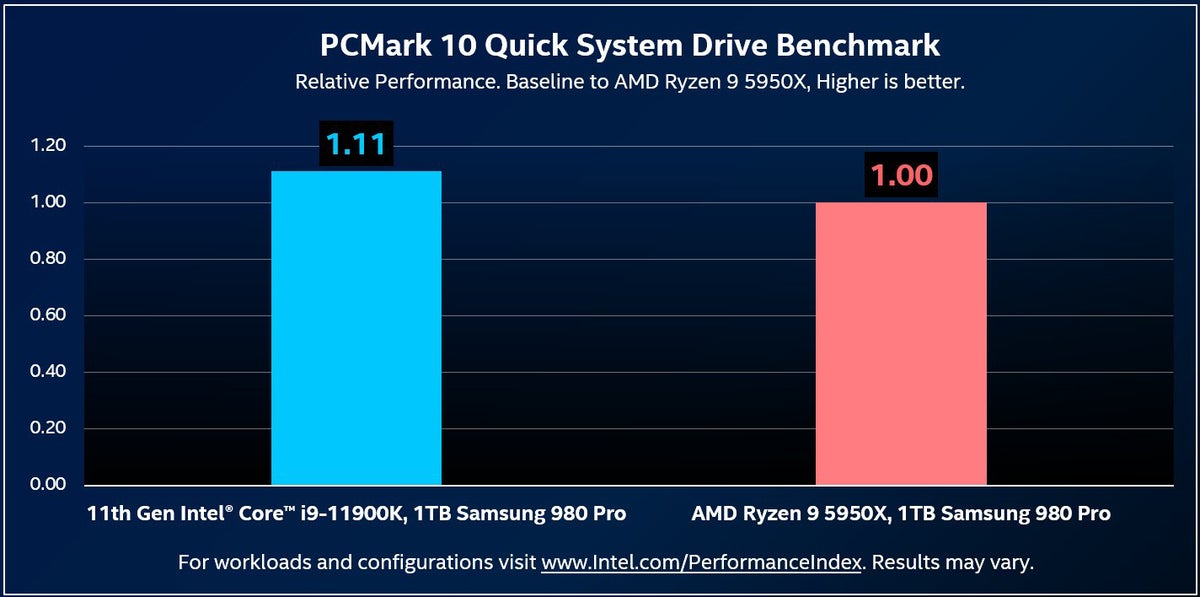
Intel's 11th gen Rocket salad Lake-S is still sitting on the launch pad, but the company isn't wasting away whatsoever clock time in promoting it. On Tuesday, Intel teased storage performance results that register a Rocket Lake-S outperforming a Ryzen 9 5950X by 11 percent.
The results were tweeted aside Intel's Ryan Shrout, who works as Intel's Chief Public presentation Strategist. You can watch the 11 percent delta below.
 Intel
Intel Intel says the upcoming 11th gen Core i9 will outperform AMD's Ryzen 9 5950X in PCMark 10's storage essa of PCIe 4.0 storage.
First let's describe how the tests were establish, then jump to the "Wherefore does this matter?" section to make sense of it all.
Intel's 11th-gen Rocket Lake warehousing prove
Intel publicized inside information of its internal test, only the short story is the Ryzen 9 5950X was in an Asus X570 control panel with 32GB of DDR4/3200; an Intel 512GB 760P was used for the boot OS; and a Samsung 980 Pro was the target drive on which to run the test. Intel also frame an 11th gen Core i9-11900K in an Asus Z590 gameboard with the same Random memory and store configurations.
The tests were run by Intel's Computer memory Technical Psychoanalyst Allyn Malventano, who installed the M.2 Samsung 980 Pro drives in PCIe riser pipe cards to see to it they were running off the Central processing unit's PCIe 4.0 lanes.
PCMark 10 is best known for its application tests, but its storage tests are popular A well. Unequal typical synthetic tests that may hammering a drive to find its theoretical throughput—completely under scenarios that may non match what nearly people do day-after-day— PCMark 10 is built around decipher tests. A trace test basically records a drive usage pattern when using Microsoft Surpass, PowerPoint, Adobe brick Illustrator, and Photoshop, or introduction Battlefield V or Call of Tariff Black Ops and other applications. That pattern is then replicated along a drive and the performance is recorded.
 UL
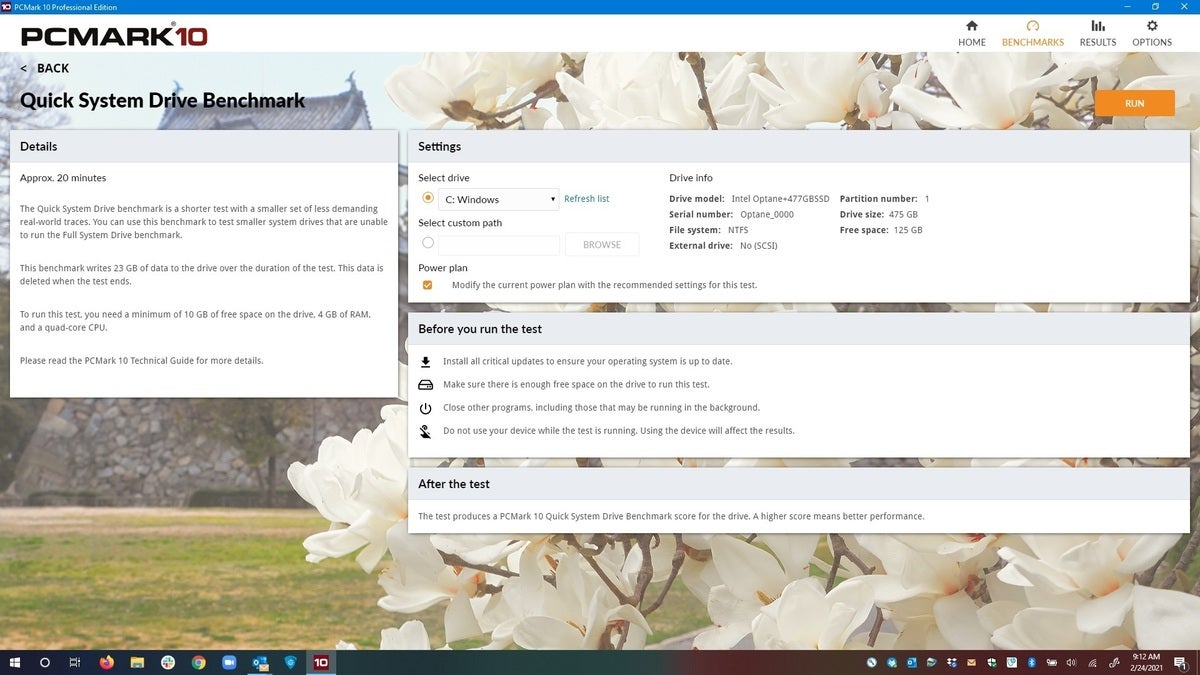
UL PCMark 10's Quick Storage Drive uses traces of real-world applications and scenarios to gauge a cause performance.
For Intel's leave, it ran the Quick Organisation Drive Benchmark, which uses traces when writing 339 JPEG files totaling 2.37GB to the tug, reading the same files, and too copying the said files to the screw a read and write out scenario. The Quick Arrangement Drive also dozens the drive performance using Microsoft Excel, Adobe Illustrator and a light usage scenario for Adobe brick Photoshop. The test takes roughly 20 minutes to run its three passes, which write about 23GB of information.
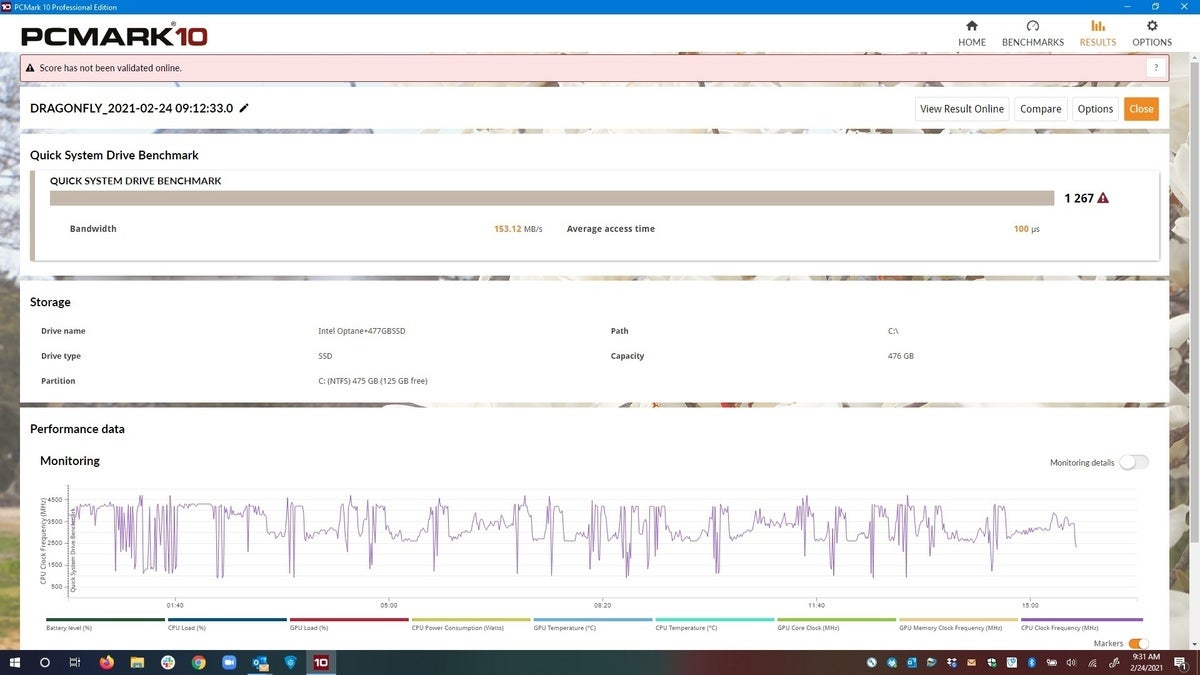
You seat see the termination of PCMark 10's Quick System Push back bench below happening a Core i7-8665U laptop. The resulting bandwidth is fairly baritone for a quiz, but PCMark 10's tests are focused along real utilization patterns. This as opposing to blasting a drive with data to find its vividness point.
It's same much like evaluating a car's performance on a daily exchange rather than a quarter-mi get behind strip carrying into action. Drag strip performance is sport, but 99 percent of the time, you never get to go that fast.
 IDG
IDG PCMark 10 results on a yield Optane H10 screw an HP Dragonfly laptop with Core i7-8665U.
Why does this matter?
Because PCMark 10's Quick System Drive test is designed to measure a motor's performance, not a CPU's performance, Intel's flex is likely meant to show the company's depth and breadth in areas other than pure CPU performance.
With both the Ryzen 9 5950X and Core i9-11900K using the exact unvaried 1TB Samsung 980 Pro drives in PCIe 4.0 style, an 11 percent advantage might indicate device driver optimizations, control board BIOS optimizations, and better PCIe 4.0 implementations.
IT might also show that being last to PCIe 4.0 helps too. Early implementations of new technology seldom end up being the best optimized. So Rocket Lake arriving to PCIe 4.0 almost two years behind AMD might follow serving IT considerably.
Of course, this isn't the first time Intel has claimed a performance advantage ended its arch nemesis. During a virtual 2021 CES seance, Intel showed off results indicating Rocket Lake 11th gen was faster than AMD's Ryzen 9 5900X in play.
Should you think information technology?
Whatever sentence a vender makes performance claims, you should ever be skeptical—afterward all, who shows off tests that make them look worse? However, assume't reach the misidentify of dismissing all of this as "fake benchmarks." It's unlikely these are wangle. And while they whitethorn be "cherry-picked," information technology's best to wait for a full view of a sunrise mathematical product from duplex independent reviewers. So you can prepar informed decisions.
Source: https://www.pcworld.com/article/394136/intel-fires-a-shot-at-amds-storage-performance-heres-what-to-believe.html
Posted by: mateocorbarty.blogspot.com
0 Response to "Intel fires a shot at AMD's storage performance - mateocorbarty"
Post a Comment